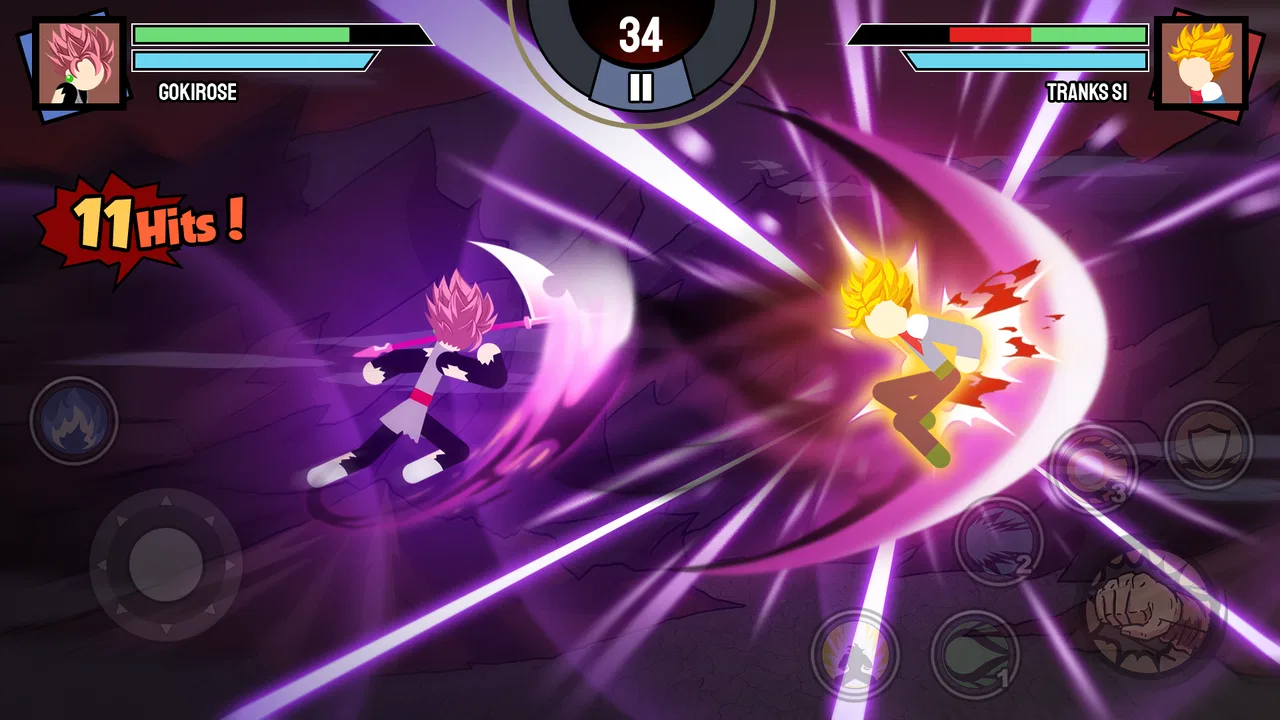
Stickman Warriors
- 4.7
- Rating
- 100.00M
- Installs
- Free
- Price

 Analysis by App-foxy
I spent time with Stickman Warriors as a quick-action game built around choosing a hero, entering fights, and chasing the feeling of becoming stronger. That basic idea is easy to understand, but the real question is whether the game stays enjoyable after the first few sessions, especially when free-to-play spending enters the picture. My overall impression is positive: it is approachable, energetic, and well suited to short bursts, although players who want a deeply transparent progression system or a carefully balanced competitive experience may need to look elsewhere.
It comes from SkySoft Studio and sits in the action category. The game is free to download, carries an Everyone 10+ age rating, and has grown to over 100 million installs. Its average rating is 4.7 from around 974 thousand ratings, with roughly 28 thousand written reviews. Those numbers suggest that the straightforward combat loop has found a broad audience, but popularity alone does not tell me whether it matches every player’s expectations. I found it most appealing when I treated it as a compact action game rather than as a complete replacement for a larger console-style fighting title.
How the hero-and-fight loop feels in daily play
I find the hero-and-fight loop easiest to enjoy when I give each session a small purpose: get comfortable with one warrior, then see whether a new choice changes how I approach a tough encounter. That keeps quick play from turning into aimless repetition and helps me notice when I’m ready to stop. From there, the next useful question is how the game feels when I play for longer stretches.
You May Also Like

 Blood Strike: 2.5 Anniversary
Blood Strike’s Loadouts Turn Every Drop Into a Tactical Gamble
A close look at Blood Strike’s custom loadouts: how fast access to signature weapons reshapes its battle royale rhythm, rewards preparation, and narrows the gap between fights.

 Pandora - Music & Podcasts
Pandora’s Music Is Easy to Start, but Harder to Recover
Pandora’s strength is its low-effort path from a seed to a station. Its weak spot is how much confidence it asks you to place in connection, setup, and quiet recovery.

 8 Ball Pool
 Is Built on Rivalries, Rematches, and Routine
A close look at the rivalries, rematches, shared routines, and unanswered safety questions that turn a quick pool match into a persistent mobile community.

 Samsung Music
’s Quiet Strength Is Playing What You Already Own
Its reach comes less from spectacle than from dependable access to a personal library. That simplicity is both the app’s strongest retention engine and its ceiling.

 AccuWeather: Weather Radar
AccuWeather Review: A Quick, Clear Forecast for Everyday Decisions
For everyday plans, the best forecast is the one you can understand quickly. AccuWeather makes rain timing, radar, and local conditions easy to act on, with a few trade-offs.

 Hill Climb Racing
Why Hill Climb Racing Still Turns Crashes Into One More Run
A tiny car, a bumpy hill and one more upgrade: Hill Climb Racing keeps resurfacing because its simple chaos makes every near-miss feel personal.
More From Our News Desk
View All News


A simple premise that gets you moving quickly
The central appeal is immediate. I can choose a favorite hero, head into a fight, and focus on action instead of learning a complicated set of menus before playing. That simplicity is useful on a phone because it makes the game easy to pick up during a short break. If I have only a few minutes while waiting for an appointment, the basic structure gives me a clear reason to open it: select a character, fight for justice, and work toward becoming a stronger warrior.
That accessibility also explains why the game works well for younger players within its age rating. The presentation is built around stylized stickman warriors rather than realistic violence, and the premise is easy to understand without a long story explanation. I would still guide younger players through the purchase options, because the game includes optional in-app purchases ranging from $0.49 to $30.99 per item. The age label makes it approachable, but it does not remove the need for sensible spending controls.
One useful way to play is to separate practice sessions from progress sessions. When I want to improve, I pay attention to how a hero behaves in battle instead of immediately switching characters after a difficult encounter. When I only want entertainment, I accept a few rough fights and stop before frustration turns a short break into a grind. That distinction matters because action games can feel much less enjoyable when every loss is treated as a demand to spend or upgrade.
What makes the progression satisfying, and what can make it tiring
The promise of becoming stronger gives each fight a purpose beyond simply winning the current encounter. I like that sense of forward movement because it creates a small decision after a session: continue pushing with the current hero, try a different favorite, or step away and return later. The strongest part of the loop is the combination of immediate action and longer-term improvement. The weakest part is that any upgrade-focused game can make ordinary victories feel less meaningful if progress slows too sharply.
My advice is to establish a personal stopping point before playing. For example, I might complete a few fights, test whether my chosen hero still feels comfortable, and then close the game rather than chasing one more win. This is not a feature claim; it is a practical way to keep a free action game in its proper place. The moment progress becomes the only reason to continue, the experience can start feeling like work instead of play.
Players who enjoy experimenting should avoid locking themselves emotionally to one hero too early. A favorite character may feel satisfying, but trying another option can reveal whether a difficult encounter is genuinely a skill problem or simply a poor match for the way I am playing. That is one of the more useful habits I found: use failures as information about the hero and the fight, not automatically as evidence that spending is necessary.
A realistic everyday scenario
Imagine opening the game during a commute with a limited amount of attention available. I would choose a familiar hero, play a small number of encounters, and stop after a clear success rather than beginning a long session. On a quiet evening, I might instead compare heroes and look more closely at how my decisions affect the outcome. The same game serves both situations because its appeal is not dependent on a long uninterrupted sitting.
That flexibility is a genuine strength compared with larger action games that expect extended sessions, constant online attention, or a more involved story commitment. Stickman Warriors is easier to approach when I want direct combat without a large fictional world to study. On the other hand, players who want a rich campaign, elaborate character relationships, or a fighting system designed for serious mastery may find the compact format too limited.
Spending, progress, and the pressure to continue
The purchase range is important context. A free download lowers the barrier to trying the game, while optional items priced from $0.49 up to $30.99 create very different levels of commitment. I would not treat the presence of purchases as proof that the game is unfair, and I would not assume that buying something guarantees a better experience. The sensible approach is to play long enough to decide whether the combat itself is enjoyable before paying for anything.
I also recommend checking whether a purchase solves a problem you actually have. If I am bored with the fights, an item is unlikely to fix that. If I already enjoy the game and want to support it or make a particular part of progress more convenient, the decision is easier to justify. The key trade-off is simple: spending may reduce friction, but it can also remove the satisfaction of earning improvement through play.
Because the listed purchase range includes a much higher-priced item, I would keep device-level purchase protections active, particularly on a shared phone or a child’s device. That is practical advice rather than a claim about how the game pressures players. The confirmed facts establish that purchases exist and vary in price; they do not, by themselves, establish how often the game presents them or how essential they are.
How fair does the action feel?
Fairness is harder to judge from the broad premise alone than responsiveness or accessibility. I can assess whether I enjoy choosing heroes and fighting, but I should be careful not to label the game pay-to-win without a clear understanding of how purchases affect outcomes. The available purchase information confirms the price range, not the exact role of every item. For that reason, my verdict is cautious: I would test the free experience first and judge fairness by whether ordinary play continues to feel meaningful without buying.
For a casual player, fairness may simply mean that a defeat feels understandable. If I lose because I made a poor decision, I can try again. If every setback appears connected to a stronger paid option, enjoyment drops quickly. I would pay attention to that distinction during the first sessions. A game can be generous with free content and still feel uncomfortable if it repeatedly turns normal progress into a spending prompt.
Competitive-minded players should be especially careful about their expectations. The game’s action focus may be enjoyable as a personal challenge, but I would not assume that it offers the same kind of carefully controlled competitive environment as a dedicated esports fighter or a skill-first multiplayer title. If ranking integrity, tournament-level balance, or a fully documented match system is your priority, a specialized alternative is probably a better fit.
Where it differs from familiar alternatives
Compared with a traditional fighting game, this title is less intimidating. The stickman presentation keeps the focus on movement, attacks, and the selected hero rather than on a large roster of complicated inputs or a dense narrative. That makes it a good first step for someone who wants action without studying a manual. It is also more convenient than many premium action games because the initial download is free.
Compared with endless runners, it offers a stronger sense of confrontation. I am not merely trying to survive a repeating path; I am choosing a warrior and engaging with a justice-themed combat goal. That gives each session a more deliberate feeling. However, players who prefer relaxed repetition and almost automatic progress may find direct fights more demanding than a runner’s rhythm.
Compared with large role-playing games, the trade-off is even clearer. Stickman Warriors is quicker to understand and less demanding of storage, time, and attention as a concept, but it does not promise the same breadth of exploration or storytelling. I would recommend it to someone who wants action first. I would skip it for a player whose main reason for gaming is discovering a detailed world or building a complex party.
Questions I would settle before downloading
The first question is whether it is genuinely free to try. Yes, the game is free, but optional purchases are available, so I would approach it as a free-to-start experience rather than assuming every part of progression will feel identical without spending. The second question is whether an older phone can run it. The minimum operating system is Android 7.0, which makes the stated compatibility broad enough for many older Android devices, though real performance can still depend on the phone itself.
The third question is whether the game is suitable for children. Its content rating is Everyone 10+, so it is aimed at a wide audience, but the purchase range means I would still use parental controls on a shared device. The fourth question is whether the game is current. The version shown is 2.1.5, and the release date is March 8, 2020. That gives useful context: it is an established title rather than a brand-new experiment, but I would not confuse age with guaranteed depth or ongoing personal appeal.
The final question is whether the high rating means I will automatically enjoy it. Not necessarily. A 4.7 average and a large audience are encouraging signs, but they cannot predict whether I prefer quick stickman combat over a premium fighter, a story-heavy action game, or a competitive title. I would use the free entry point to make that decision instead of relying only on the score.
Who should play it, and who should pass?
I would recommend it to casual action fans, players who enjoy choosing between heroes, and anyone looking for a direct mobile game that can fit around a busy day. It is also a reasonable option for someone who likes the visual charm of stickman characters and wants a clear justice-versus-strength premise without a complicated introduction. The large install base and strong average rating make it easy to understand why the game attracts attention, though they should be treated as context rather than a promise.
I would be more hesitant to recommend it to players who dislike in-app purchases on principle, even when the download itself is free. I would also steer away anyone seeking a transparent competitive rule set, a deep story campaign, or a premium experience with no spending prompts. If your ideal action game is measured by frame-perfect balance and long-term tournament practice, a dedicated fighting game should serve you better.
My practical recommendation is to begin with a no-spend trial. Choose a hero that feels natural, play enough encounters to see whether defeats teach you something, and notice how you feel when progress slows. If the combat remains enjoyable without treating purchases as a solution, the game has earned a place in your rotation. If your interest depends mainly on unlocking faster progress, that is a sign to stop before the free download becomes an expensive habit.
My trust verdict after weighing the trade-offs
Stickman Warriors succeeds because it makes the basic fantasy easy to grasp: pick a warrior, fight, and pursue greater strength. SkySoft Studio has built a game with broad reach, a low entry barrier, and enough action appeal to work in short sessions. I enjoyed it most when I focused on learning my chosen hero and treated progress as a bonus rather than as an obligation.
My reservation is not that purchases exist, but that spending can change how a player experiences progress. The listed items range from small to substantial amounts, so I would keep a firm budget and avoid buying during a frustrating losing streak. I also would not make strong claims about competitive fairness without seeing exactly how purchases interact with play. That uncertainty is a reason to test carefully, not a reason to dismiss the game outright.
My bottom line: try it for the combat, not for the promise that spending will solve every obstacle. For quick, approachable action with a stickman identity, it is worth a look. For a no-purchase environment, a deep campaign, or highly controlled competition, another type of game will likely be a better match. In my experience, the best way to enjoy this one is to keep the sessions intentional, protect your spending limits, and let the quality of the fights—not the size of the upgrade path—decide whether you stay.
FAQs for Stickman Warriors
01What is Stickman Warriors, and what can I expect from the gameplay?
Stickman Warriors is an action-packed fighting game where players control stick figure characters in epic battles. The gameplay involves a mix of martial arts and special moves, with an intuitive control system that allows for dynamic combat. Each character has unique abilities, and players can engage in both single-player and multiplayer modes. Expect fast-paced action and strategic challenges.
02Does Stickman Warriors require an internet connection to play?
Stickman Warriors offers both online and offline gameplay modes. While some features, such as multiplayer battles or accessing certain online events, require an internet connection, you can enjoy the single-player campaign and practice modes without being connected. This flexibility makes it convenient for gaming on the go.
03Are there in-app purchases in Stickman Warriors, and are they necessary?
Yes, Stickman Warriors includes in-app purchases that allow players to buy additional characters, weapons, and power-ups. While these purchases can enhance your gameplay experience, they are not necessary to enjoy the game. Players can progress through skillful play and earn rewards through regular gameplay, making it accessible for those who prefer not to spend extra money.
04How often does Stickman Warriors receive updates or new content?
The developers of Stickman Warriors frequently release updates that include new characters, levels, and features to keep the game fresh and engaging. These updates often coincide with community feedback and seasonal events, ensuring a dynamic gaming experience. Checking for updates regularly is recommended to enjoy the latest content and improvements.
05Is Stickman Warriors suitable for younger players, and what is the age rating?
Stickman Warriors is rated for a broad audience, but it does contain animated violence typical of fighting games. Parents should consider whether the fast-paced action and combat themes are suitable for their children. The game includes parental controls to restrict in-app purchases and manage playtime, making it easier to align with family guidelines.
Pros
- Engaging combat mechanics
- Variety of characters to unlock
- Smooth
- responsive controls
- Vibrant
- minimalist graphics
- Frequent updates with new features
Cons
- Ads can be intrusive
- Limited character customization
- Repetitive background music
- In-app purchases necessary for progression
- Occasional lag on older devices

Stickman Warriors
Gallery